Decide the radios first, then look at the price
There are four standards that matter and only one of them is optional for most people.
Matter is the interoperability layer. Almost everything new supports it, and almost anything that calls itself a hub can act as a Matter controller — which is why the cheapest pick on this page qualifies at all. Our Matter explainer covers what it does and does not fix, and the best Matter devices is the shopping list.
Thread is the low-power mesh Matter often rides on. Three of the four picks publish a Thread radio; one publishes a Thread border router specifically, which is the part that lets Thread devices reach the rest of your network.
Zigbee is where the cheap sensors live — door contacts, motion, buttons. Two picks here have it.
Z-Wave is the one that splits this page in half. Exactly one hub under $200 speaks it, and it matters because Z-Wave gear is long-lived: if you have inherited Z-Wave locks or sensors from a previous owner or an old SmartThings setup, three of these four hubs cannot talk to them at all. Our Zigbee vs Z-Wave vs Thread guide is the longer version of that argument.
Side by side, using only what each maker publishes
Published specifications only, read from each maker's own pages. The last two columns are hubs just above this page's ceiling, for context. Prices are live from the retailer and dated on each button.| Spec | Hubitat C-8 Pro | Echo Dot (5th Gen) | Aeotec Hub 2 | Echo Hub | Homey Pro mini (over) | Homey Pro 2026 (over) |
|---|
| Matter | Yes | Yes, as a controller | Yes | Yes | Matter v1.5 | Matter v1.5 |
|---|
| Thread | Not published | Not published | Yes, border router | Yes | Yes, border router | Yes, border router |
|---|
| Zigbee | Zigbee 3.0 | No | Zigbee 3.0 | Yes | Zigbee 3.0 | Zigbee 3.0 |
|---|
| Z-Wave | Z-Wave 800 | No | No | No | Only with the Homey Bridge | Z-Wave 700 |
|---|
| Automations run locally | Yes, on the hub | No, Alexa cloud | Most run on the hub when the internet drops, per Aeotec | No, Alexa cloud | Yes, on the box | Yes, on the box |
|---|
| Network | Ethernet or Wi-Fi | Wi-Fi + Bluetooth | Wi-Fi or Ethernet | Wi-Fi (adapter or PoE) | Gigabit Ethernet only | Wi-Fi 2.4/5GHz |
|---|
| Screen | None | None | None | 8-inch wall panel | None | None |
|---|
| Voice built in | No | Yes, Alexa | No | Yes, Alexa | No | No |
|---|
| Apple Home | No | No | No | No | Yes | Yes, as a HomeKit experiment |
|---|
| Subscription for control | None | None | None | None | None | None |
|---|
| Check price | $184.76 · View on Amazon$194.955% off Price as of November 22, 2026. #ad How we’re funded | $39.99 · View on Amazon$79.9950% off Price as of November 22, 2026. #ad How we’re funded | | $74.99 · View on Amazon$179.9958% off Price as of November 22, 2026. #ad How we’re funded | $219.00 · View on Amazon$249.0012% off Price as of November 22, 2026. #ad How we’re funded | $399.00 · View on Amazon$449.0011% off Price as of November 22, 2026. #ad How we’re funded |
|---|
The Z-Wave row and the automations run locally row are why the most expensive hub under this ceiling is also the top pick. Everything else on this page is either a cloud hub with good radios or a cheap controller with almost none.
Why the Hubitat C-8 Pro wins under $200
It is the only hub under the ceiling that carries Z-Wave 800, Zigbee 3.0 and Matter together, and the only one whose automations run on the box. That second point is the one people underrate until the first outage: a cloud hub with a dead internet connection is a brick with a status light, while a local hub keeps running the schedule it already knows. There is no subscription for control or automation, and the community around it is unusually deep for a product this niche.
The honest cons. The learning curve is real — this is a hub you configure rather than one you unbox. There is no voice speaker in it, so it pairs with an Alexa or Google device for voice rather than replacing one. Setup is hands-on. And Hubitat does not publish a Thread radio for this model, so a Thread-only Matter device needs a border router elsewhere in the house. Our full review and Hubitat vs Home Assistant both go into how much tinkering it actually asks for.
Why the Echo Dot is the budget pick
Because the honest answer to “what is the cheapest thing that will work as a hub” is a $45 speaker. The Echo Dot (5th Gen) acts as a basic Matter controller, so a Matter plug or bulb paired to it can be controlled from a phone and by voice, and it is a genuinely good little speaker as well. For a household whose smart home is four plugs and some bulbs, buying a $185 automation hub instead would be spending $140 on capability nobody is going to use.
The honest cons. No Zigbee — that is the pricier Echo Hub — and no Z-Wave, so the cheap sensor shelf is out of reach. Automations run in Alexa’s cloud, not on the device, so an internet outage takes your routines with it. It is Alexa lock-in by design. And it has an always-listening microphone, which does not suit every household; if that is the objection, our privacy-first hub comparison is the page to read. Amazon’s newer Echo Dot Max is a pricier, better-sounding speaker; the 5th Gen remains the cheap way in.
Why the Aeotec Smart Home Hub 2 is here for SmartThings
If you want the mature SmartThings platform without going fully DIY, this is the box that runs it: Zigbee 3.0, Thread with a border router and Matter, with Aeotec stating that most automations and controls run on the hub when the internet drops. It works alongside Alexa and Google rather than against them, and there is no subscription for control.
The honest cons. It dropped the Z-Wave radio the original Aeotec hub had — so if you own Z-Wave gear this is the wrong hub and the Hubitat is the right one. Some features are tied to Samsung’s cloud, and the interface has a learning curve of its own. If you are weighing SmartThings against the alternatives, that is the subject of SmartThings alternatives and SmartThings vs Home Assistant.
Why the Echo Hub is the pick for an Alexa household
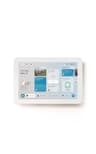
It is the only hub under this ceiling with a screen, and that turns out to matter: an 8-inch panel on the hall wall is how the rest of the household interacts with a smart home without learning an app. Amazon puts Zigbee, Thread and Matter radios inside it, so it is a real hub rather than only a dashboard, and it mounts with an adapter or over PoE.
The honest cons. It is Alexa-centric and much less useful outside that ecosystem. It wants wired power and proper mounting to look like the product in the photographs. There is no Z-Wave. And it is frank overkill if your smart home is a handful of devices — the Echo Dot above does the control job for a quarter of the money. The Echo Hub review has the detail, and Alexa vs Google Home is the page if you have not picked an ecosystem yet.
What the money above $200 buys
Every radio at once. The Homey Pro (2026) carries Z-Wave 700, Zigbee 3.0, a Thread border router, Matter v1.5, Bluetooth LE and infrared in one box, runs automations locally, and Homey commits to updates until at least June 2031. Two caveats we publish because Homey does: its 433 MHz transmission is switched off in the US, Canada and South Korea, and it has no Ethernet port — the adapter is sold separately.
The same software on cheaper hardware. The Homey Pro mini runs the full Homey platform over Gigabit Ethernet with Zigbee, Thread and Matter, and sat just above this page’s ceiling when we priced it. It has no Z-Wave, Bluetooth, infrared or 433 MHz without the separate Homey Bridge, and 1 GB of RAM, which is why Homey guides buyers toward roughly 20 to 25 apps. Homey Pro vs Hubitat is the head-to-head if you are weighing the step up.
What we left off, and why
The Home Assistant Green. It is the most capable and most private option at roughly this price — Home Assistant publishes a $199 recommended price for it, which is inside this page’s band. It is not ranked here because we could not read a live retail price for it: as of our last check Amazon had no listing for it in any condition, and this site does not print a price it cannot read from the dated price layer. Home Assistant lists its authorised distributors on its own Green page, so check there rather than assume it has gone. The review stands.
The Apple HomePod mini. It is the way into Apple Home and it was under $200, and we left it out for a listing reason rather than a product one: Apple has replaced it with the HomePod mini 2, and as of our last check exactly one first-generation color on Amazon carried an offer at all — sold by a third-party marketplace seller, sitting in Amazon’s Renewed catalog with a 90-day renewed warranty and a future availability date. We will not put a renewed-catalog listing at the top of a price-capped page. For an Apple household, our Apple Home device ranking is the better starting point.
Camera sync modules and bridges. The Blink Sync Module 2 and Sync Module XR both sit well under $200 and both get called hubs. They are camera accessories: they do not control a lock, a bulb or a thermostat. Including them to lengthen this list would be padding.
So which one
Most people who want real automation: the Hubitat C-8 Pro. Z-Wave, Zigbee and Matter in one box, running on your shelf rather than in someone’s cloud.
Spending the least: the Echo Dot (5th Gen). A Matter controller for the price of dinner, if your smart home is plugs and bulbs.
You are committed to SmartThings: the Aeotec Smart Home Hub 2. The current hardware for the platform — just not if you own Z-Wave gear.
You are committed to Alexa and want a wall panel: the Echo Hub. The only screen under this ceiling, with real radios behind it.
Not sure which ecosystem you are in yet? Start with the smart home ecosystems comparison — it is a more consequential choice than the hub itself.