How night vision actually works, in one section
Every camera on this page does the same thing when the light drops below what its sensor can use: it switches on infrared LEDs and records in black and white. Ring describes this as switching “to sharp black and white infrared imaging” when the environment goes fully dark; Blink describes its cameras using an 850nm infrared LED “to show you clear video in areas of complete darkness,” resulting in black-and-white imagery. That is the baseline, and every pick here has it.
The wavelength matters a little. 850nm emitters, which most cameras use, reach farther but show a faint red glow up close — you can usually see the ring of LEDs at night. 940nm emitters are essentially invisible to the eye at the cost of range. TP-Link is the only maker here that publishes both on the same camera: the Tapo C120 lists 850nm and 940nm LEDs, each rated to 30 feet. Arlo publishes dual 850nm LEDs rated to 25 feet on the Pro 6th Gen. Wyze lists four 850nm LEDs on the Cam v4; Reolink lists two 850nm LEDs on the Argus PT Ultra. eufy states “infrared & color night vision” without a range figure. Where a range is not published, we do not invent one.
Color at night: sensors versus spotlights
“Color night vision” is where listings get slippery, because there are two ways to get it and they behave differently.
The first is a sensitive sensor. Wyze, TP-Link and eufy all describe a starlight sensor on the cameras here: a sensor that pulls a color image out of very little ambient light. Ring’s phrasing for its own version is the honest one for all of them: Color Night Vision “adds color to video in low light” — low light, not no light. Under a streetlamp, beside a lit porch, or in a room with a hallway light on, these sensors stay in color where a plain camera would already have gone to infrared. In a pitch-dark yard they cannot, and the camera falls back to infrared like everything else.
The second is a light. Every pick here has a built-in spotlight that comes on with motion: eufy lists it as “built-in, motion-activated,” Wyze publishes two white LEDs at 72 lumens, Reolink publishes two 2.4W 6500K spotlights with a 33-foot range, TP-Link lists dual spotlights on the C120 alongside the infrared, and Arlo lists an integrated spotlight. A spotlight guarantees a color clip in total darkness, because it makes its own light. The trade is that it announces the camera, which some people want (a visible deterrent) and some do not (a camera you would rather nobody noticed). If the second camp is you, weigh the infrared row of the table more heavily than the spotlight row.
Resolution matters more at night, not less
Infrared footage is where a low-resolution sensor gives up first, because the image is already noisy and monochrome. That is why this ranking leans toward the 4K and 2K cameras: eufy publishes 4K (3840 x 2160) on the S330, Reolink publishes 4K at 15fps on the Argus PT Ultra, Wyze publishes 2.5K (2560 x 1440) on the Cam v4, TP-Link publishes 2K QHD 4MP on the C120 and Arlo publishes 2K with HDR on the Pro. A 1080p camera can be a perfectly good night camera — Ring and Blink both sell them — but in the same scene it has fewer pixels to spend on a face, and at night every pixel is working harder. Reolink’s 15fps figure is worth knowing too: it is enough for identification, and Reolink is the only maker here that publishes a night frame rate at all, so we cannot rank the others on it.
The picks compared
Manufacturer-published figures only, read on the date at the top of the page. 'Not published' or 'not stated' means exactly that. | eufyCam S330 | Reolink Argus PT Ultra | Wyze Cam v4 | Tapo C120 | Arlo Pro 2K (6th Gen) |
|---|
| Resolution | 4K | 4K at 15fps | 2.5K | 2K QHD | 2K HDR |
|---|
| Infrared | Yes (range not published) | 2 x 850nm | 4 x 850nm | 850nm + 940nm, 30 ft | 2 x 850nm, 25 ft |
|---|
| Color low-light sensor | Starlight | Not stated | Starlight | Starlight | Color night vision |
|---|
| Spotlight | Built-in, motion-activated | 2 x 2.4W, 33 ft | 2 LEDs, 72 lm | Dual spotlights | Integrated |
|---|
| Field of view | 135° | 110° diagonal, 355° pan / 140° tilt | 115.8° diagonal | 120° diagonal | 160° diagonal |
|---|
| Power | Battery + integrated solar | Battery + solar panel | Wired USB | Wired | Battery (solar sold separately) |
|---|
| Footage lives on | HomeBase, 16GB to 16TB | microSD to 512GB | microSD to 256GB | microSD to 512GB | Arlo cloud (plan) |
|---|
| Monthly fee to record | None | None | None | None | Arlo Secure required |
|---|
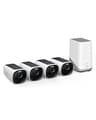
Read down the bottom row first and the ranking explains itself. Four cameras record their night footage to storage you own. The eufy kit is first because it is the only one that combines 4K, a color low-light sensor, a spotlight and an integrated solar panel with a base station that never charges rent — eufy publishes 16GB built in, expandable to 16TB. The Reolink is second because a pan-and-tilt camera that publishes a 33-foot spotlight range covers a whole yard after dark from one mount, and it takes a 512GB card. The Wyze and Tapo are the cheap plug-in answers, and which one is “better” depends on the spot: the Wyze has the sharper sensor and 4 infrared LEDs; the Tapo has the 940nm option for a spot where you do not want a visible red glow, a 512GB card ceiling and an IP66 rating. The Arlo publishes the most complete night specification on the page and sits fifth for one reason, covered next.
Why the Arlo is fifth
Judged purely on the night-vision spec sheet, the Arlo Pro 2K (6th Gen) would be near the top: dual 850nm LEDs with a published 25-foot range, color night vision, an integrated spotlight, 2K with HDR and the widest lens here at 160 degrees. It is also the only camera on this page that stores nothing without a plan. Arlo’s own plan page says that without a service plan you keep live streaming and two-way audio; the recorded clip of whatever the spotlight caught is an Arlo Secure feature. A night-vision camera whose night footage you cannot review without a subscription is, for the purposes of this site, a live-view camera with excellent optics. If you have already decided to pay Arlo, it is a genuinely good choice — read the full Arlo Pro review and the Ring vs Arlo comparison first. If you have not, the four above it do the job for free.
Placement decides more than the sensor does
Two placement mistakes ruin more night footage than any spec. The first is pointing a camera through a window. Every brand here says the same thing about that: TP-Link warns that infrared “may cause reflection” off glass in night mode, Ring says the infrared light “can be turned off to avoid lights reflecting back into the camera,” and Arlo says motion detection “does not work through windows reliably.” If an indoor camera has to watch outdoors, read can a security camera see through a window? before you buy one.
The second is height and angle. Ring’s positioning guidance is a reasonable rule for any brand: outdoor cameras mounted 8 to 10 feet up with roughly a 20-degree downward tilt, which keeps faces in frame and keeps the infrared from spraying across a wall two feet away. Our guide to where to place security cameras covers the rest, and how many cameras you actually need is the question to answer before you buy a kit.
Battery cameras at night: the detection catch
One more thing the spec sheets tell you if you know where to look. The eufy, Reolink and Arlo cameras here run on batteries and wake up on a motion sensor — eufy publishes “radar and PIR,” Reolink publishes PIR detection. A passive infrared sensor detects body heat, which is what lets a battery camera sleep for months, and it is also why battery cameras miss more at long range and through glass. The two plug-in cameras, the Wyze and the Tapo, are always awake and can record continuously to their cards — Wyze publishes “24/7 local recording,” and TP-Link’s continuous-recording FAQ states that battery cameras do not support it. If “did it catch everything last night?” is the question that keeps you up, that distinction matters more than any infrared range; our guide to whether cameras record all the time explains it, and wired vs wireless cameras covers the power trade-off behind it.