Problem one: there is no outlet
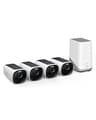
Most garages have a light and, if you are lucky, one socket near the door opener. Neither is usually where you want the camera. That leaves three honest options, and all three are represented above.
The first is a battery camera with solar. Reolink publishes a solar panel option for the Argus PT Ultra and eufy builds an integrated solar panel into the eufyCam S330, which turns the power question into a question about where the sun falls on your garage rather than where the wiring runs. On a south-facing wall this is genuinely set-and-forget.
The second is plain batteries. Blink publishes two AA lithium batteries rated for up to two years in the Outdoor 4, which is the least demanding camera here to own: you climb a ladder once every couple of years rather than every couple of months.
The third is a cable, and if you can run one you should. A plug-in camera is always awake, so it can record continuously instead of waking on motion, and it never needs charging. Wyze publishes 24/7 local recording to a microSD card on the Cam v4; TP-Link states the same capability for wired Tapo cameras and says plainly that its battery-powered models do not support continuous recording. eufy makes the same admission about its own battery cameras: a battery-operated camera will not record continuously even when connected to a HomeBase. That is the real trade, and it is the reason the cheap wired camera outranks two expensive wireless ones for an attached garage.
Problem two: your Wi-Fi may not reach
A detached garage is often one wall and twenty yards too far. The published spec that matters here is the Wi-Fi band. Blink lists the Outdoor 4 as 2.4GHz only, and Wyze lists the Cam v4 as 2.4GHz only — which sounds like a limitation and is actually an advantage at distance, because 2.4GHz carries further through walls than 5GHz does. Reolink publishes dual-band Wi-Fi on the Argus PT Ultra, so it can take the faster band when it is close enough and the longer-range band when it is not.
The eufyCam S330 answers the problem differently and better: the cameras talk to a HomeBase, and the HomeBase talks to your router. One good link from the house to the garage carries every camera on the property, and the footage is stored on the base rather than streamed to a cloud. If the garage is the second or third place you want covered, that architecture is worth more than any single camera’s radio.
If none of that reaches, the fix is a mesh node or an outdoor access point in the garage, not a different camera. Our guide to whether security cameras need Wi-Fi covers what still works when the link drops — which, for the three local-storage cameras here, is more than you would think.
Problem three: it gets cold in there
An unheated garage in January is colder than the yard, because it holds the night air. Two makers here publish an operating range: Blink states −4°F to 113°F for the Outdoor 4, and Ring states −5°F to 122°F for its Outdoor Cam. Wyze, eufy, Reolink and TP-Link publish weather sealing — IP65 on the Cam v4 and the Argus PT Ultra, IP66 on the Tapo C120, IP67 on the eufyCam S330 — but weather sealing is about water, not cold, and a rating is not a temperature. Where a brand does not publish a range, we do not invent one.
Two practical notes that follow from the published specs rather than from a test. Lithium AA cells, which is what Blink specifies, hold up in cold far better than alkaline ones, so do not substitute cheaper batteries in a cold garage. And every rechargeable battery camera loses runtime as the temperature drops, which is the strongest argument for the solar panel on the Reolink or the eufy if your winter is a real winter.
The picks compared
Manufacturer-published figures only, read on the date at the top of this page. 'Not published' means the brand does not state that figure. | Reolink Argus PT Ultra | eufyCam S330 | Wyze Cam v4 | Blink Outdoor 4 |
|---|
| Resolution | 4K at 15fps | 4K | 2.5K | 1080p |
|---|
| Power | Battery + solar panel | Battery + integrated solar | Wired USB | 2 x AA lithium, up to 2 years |
|---|
| Wi-Fi | Dual-band | Via HomeBase | 2.4GHz only | 2.4GHz only |
|---|
| Coverage from one mount | 355° pan / 140° tilt | 135° lens | 115.8° diagonal | 143° diagonal |
|---|
| Footage lives on | microSD up to 512GB | HomeBase, 16GB to 16TB | microSD up to 256GB | Sync Module + USB, or cloud |
|---|
| Continuous recording | No (battery camera) | No (battery camera) | Yes, 24/7 to the card | No (battery camera) |
|---|
| Operating temperature | Not published | Not published | Not published | -4°F to 113°F |
|---|
| Weather sealing | IP65 | IP67 | IP65 | Weather-resistant |
|---|
| Monthly fee to record | None | None | None | None, with the right sync module |
|---|
The bottom three rows are the ranking. The Reolink is first for a detached garage because one camera on one mount covers the door, the side path and the driveway by panning, and it stores 512GB of that locally with no plan. The eufy is first if the garage is part of a whole-property job rather than a single blind spot. The Wyze is the value answer wherever a cable can reach, and the only camera here that can record every minute rather than every event. The Blink is the one to buy if you want to mount it and forget it: 1080p is the lowest resolution on the page, but a two-year battery and a sync module that keeps footage out of the cloud is a very low-maintenance garage camera. Which Blink sync module you buy decides whether that last claim is true, and our Ring vs Blink comparison spells out the difference.
Where to put it, and what to point it at
A garage camera has two jobs that pull in opposite directions: watching the vehicle door and watching the side door people actually walk through. If you can only mount one camera, mount it on the corner that sees both approaches rather than square-on to the big door — a camera pointed at a closed garage door records a closed garage door. The Reolink earns its place here precisely because panning removes that choice.
Do not point a camera through the garage window to watch the driveway. At night the infrared bounces straight back off the glass, and a battery camera cannot sense body heat through it at all, which is covered in full in can a security camera see through a window? For mounting height and angle, our placement guide gives the numbers the makers publish, and how many cameras do I need? is the question to answer before you decide the garage is the only gap.
One last thing worth knowing before you buy: a garage camera is the one most likely to be out of reach of your router and your ladder at the same time. That makes what happens when the power goes out and how long the footage is kept more important here than anywhere else on the property, because nobody checks a garage camera until the week something happens.