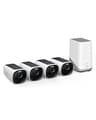
The base station question, settled with their own words
eufy’s HomeBase is the storage. eufy publishes 16GB built into the base and expansion to 16TB, and the face-recognition AI runs on the base rather than behind a paywall. The cameras talk to the HomeBase, the HomeBase talks to your router, and the footage stays in your house. There is an optional cloud plan; there is no job the system stops doing without it.
Arlo’s SmartHub is a second copy. Arlo publishes USB Type-A local storage up to 2TB on the Pro SmartHub and an Ethernet connection to your router, and it lists the Pro 2K (6th Gen) as compatible. But Arlo’s own support article on local storage says what that means: it is a second location for recordings, it cannot be used on its own as a substitute for cloud recording, and only automatically triggered recordings save locally. Arlo’s plan page is consistent with that — without a plan you keep live streaming and two-way audio.
So the two systems look alike on a shelf and behave completely differently after the first month. One of them is a camera system you own. The other is a camera system you subscribe to, with a hard drive as a backup.
The hardware, compared on published specs
Manufacturer-published figures only, read on the date at the top of this page. Arlo publishes more complete night-vision figures than eufy; eufy does not publish an infrared range. | eufyCam S330 (4-cam kit) | Arlo Pro 2K (6th Gen) |
|---|
| Resolution | 4K (3840 x 2160) | 2K with HDR |
|---|
| Field of view | 135° | 160° diagonal |
|---|
| Night vision | Infrared + color night vision, motion-activated spotlight | 2 x 850nm IR rated to 25 ft, color night vision, integrated spotlight |
|---|
| Motion detection | Radar + PIR | PIR |
|---|
| Power | Battery with integrated solar panel | Battery; solar panel sold separately |
|---|
| Weather sealing | IP67 | Published by Arlo as outdoor-rated |
|---|
| Footage lives on | HomeBase, 16GB expandable to 16TB | Arlo cloud; SmartHub USB up to 2TB as a second copy |
|---|
| Records with no plan | Yes | No — live streaming and two-way audio only |
|---|
| AI detection | On the HomeBase, included | Arlo Secure plan feature |
|---|
| Continuous recording | No (battery camera) | No (battery camera) |
|---|
| Monthly fee to record | None | Arlo Secure required |
|---|
Arlo wins the lens (160 degrees against 135) and publishes the more complete night specification, including an infrared range eufy does not state. eufy wins resolution, detection (radar plus PIR rather than PIR alone), power (the solar panel is built in rather than an accessory) and the row that matters most, the last one. If you ranked these two purely on the spec sheet it would be close. Ranked on what the system does when you stop paying, it is not close at all.
What the fee actually buys on Arlo
Worth being precise, because “subscription” has become a boo-word and Arlo’s plans are not a scam. Arlo publishes three tiers — Smart Aware, Smart Secure and Ultra Secure — and what they add is cloud recording, the AI that tells a person from a passing car, and higher-tier features above that. If you want a camera system where someone else keeps the footage safely off-site and sorts the interesting clips from the noise, that is a genuine service and Arlo does it well.
The trap is buying Arlo hardware expecting to avoid the fee by adding a SmartHub. Arlo has documented why that does not work, and it is better to read the sentence before you buy than after. If a no-fee system is what you want, eufy is the brand built for it, and our no-subscription camera ranking is where the rest of the no-fee options sit.
Where eufy costs you something
Two things, stated as plainly as we state Arlo’s.
The first is up-front price. A four-camera eufy kit with a HomeBase is a bigger single outlay than one Arlo camera, and the comparison only favors eufy once you count the months. That is the honest version of “buy once”: it is cheaper over five years and dearer in week one.
The second is eufy’s history. eufy’s past cloud-privacy disclosures are covered in our eufyCam review rather than buried, because a brand whose pitch is “your footage stays homes” has to be held to that pitch. The hardware today does what eufy publishes; the reason to read the review is to decide how you feel about the company, which is a different question from how you feel about the camera.
One shared limitation applies to both brands and catches people out: neither system records continuously, because both are battery cameras. eufy says it about its own cameras — a battery-operated camera will not record continuously even when connected to a HomeBase — and the same physics applies to Arlo. If you need every minute rather than every event, you need a wired camera; do security cameras record all the time? explains the difference, and wired vs wireless cameras covers the power trade-off behind it.
Which should you buy?
Buy the eufy kit if you want a camera system that is finished when it arrives: 4K, solar, local storage, no bill. Buy the Arlo Pro if you value the widest lens here and the most thoroughly documented night vision, and you are at peace with Arlo Secure as a permanent line item — in which case buy the SmartHub too, for the second copy rather than instead of the plan. If you are cross-shopping Arlo against the other cloud-first brand, Ring vs Arlo is the comparison that follows this one, and the best whole-home camera systems is where to start if you are covering a property rather than a door. For the night-vision angle specifically, the best cameras for night vision ranks both of these against everything else we cover.