Criterion one: what you get for nothing
This is the whole reason the page exists, so it goes first — and only one of the three publishes the answer in plain language.
Abode. Abode’s plan page answers it as an FAQ: “Do I need a subscription to use Abode? No. Abode works straight out of the box with no subscription required. You get full app access, live video streaming from connected cameras, smart home integrations with Apple HomeKit, Alexa, and Google Home, and real-time push notifications — all completely free.” Its comparison chart backs that up by putting a 10-day event timeline, live video, smart home integrations and app access in the No Subscription column. Note the one row that changes: without a plan the chart says “User action required to forward alarm to monitoring center,” and with one, “Alarm automatically forwarded.” That is the honest shape of free self-monitoring anywhere — you are the dispatcher.
Ring. Self-monitoring — app alerts, arming and disarming — is free on Ring Alarm hardware, which is why it is the cheapest route into a monitored-capable system for a household already running Alexa. But Ring publishes cellular backup as a plan feature, and its own kit page notes that cellular backup, professional monitoring and hands-free Alexa arming all require a subscription. The good news, from re-reading Ring’s plan comparison on this date: Cellular Backup is checked in every paid column, so the cheapest paid tier is enough for it — professional monitoring is the row that belongs to Ring Pro alone.
eufy. The purest answer on the page and the most limited: eufy sells the kit as a one-time purchase with no monthly fee, app control and local operation included, and offers no professional monitoring at any price. There is no plan to cancel because there was never a plan. If your objection to SimpliSafe is philosophical rather than financial, this is the system that agrees with you.
Criterion two: putting a human behind the alarm, and taking them away again
A self-monitored alarm wakes your phone. A monitored alarm wakes somebody whose job is to call the police. Most households want the first most of the time and the second for two weeks in July.
Abode is the only pick that treats that as a normal request. Its plans page publishes Standard at $8.49 a month or $79.99 a year, and Pro — the one with 24/7 professional monitoring from a US-based center, automatic dispatch and 4G cellular backup — at $26.99 a month or $245.99 a year, with this on contracts: “No. Abode plans are completely contract-free. You can subscribe month-to-month or save with an annual plan, and cancel or change your plan anytime directly from the Abode app with zero cancellation fees or penalties.” So you can run free all year, switch Pro on in the app before a holiday and switch it off when you are home. That flexibility, not the price, is why it leads this page. (One inconsistency we will flag rather than tidy away: the same page’s FAQ says plans start “at $7/month” while every plan card on it publishes $8.49. We quote the plan cards.)
Ring’s equivalent is the Ring Pro tier, which publishes 24/7 professional monitoring covering all 50 US states and Canada excluding Quebec, and Ring’s plans are month-to-month as well. The structural difference worth knowing before you buy: Ring’s plan page carries the limit “One device or location covered per plan,” which is a cheap arrangement for one alarm and an expensive one once a doorbell and three cameras join it.
eufy offers nothing here. If a staffed center matters to you at all, eufy is the wrong pick and no amount of hardware quality changes that. Our self-monitoring vs professional monitoring guide walks through what each actually does when the siren goes off, which is the decision underneath this whole page.
Criterion three: the night the internet drops
An alarm that needs your router is an alarm with an obvious weak point, and this is the criterion where SimpliSafe is genuinely strong: built-in network backup and up to 24 hours of base-station battery are published on every monitored plan, Core included.
Among the alternatives, Abode publishes 4G cellular backup — but only with the Pro plan — plus a 7.2V 600mAh pack rated at up to 12 hours of battery backup in the hub. Ring publishes an up-to-24-hour backup battery in the base station and cellular backup on any paid tier. eufy publishes base battery backup with no cellular option at all, which means a cut line or a long outage takes its remote alerts with it. For the wider version of this question, see do security cameras work without power?
What is actually in the box
Kit counts are the most misleading number in this category, because a “piece” can be a sensor or a key fob. Here is what each maker publishes, which is the only basis on which the prices above are comparable.
Contents and backup figures as published by each maker; plan structures read on the date at the top of this page. 'None published' means the company does not state it — we do not fill those in. | Abode 6-piece | Ring Alarm 8-piece | eufy 5-piece |
|---|
| Hub | Security Hub, 93dB siren, battery backup | Base station with backup battery | HomeBase 2 |
|---|
| Keypad | None — app, key fob or voice | Included | Included |
|---|
| Door/window sensors | 4 mini contact sensors | 4 contact sensors | 2 entry sensors |
|---|
| Motion sensor | None in the box | 1 motion detector | 1 motion sensor |
|---|
| Other | 1 key fob | Range extender | — |
|---|
| Openings covered out of the box | 4 | 4 | 2 |
|---|
| Connectivity | Ethernet or 2.4GHz Wi-Fi | Wi-Fi, plus Z-Wave sensors | Wi-Fi via HomeBase |
|---|
| Cellular backup | Pro plan only (4G) | Any paid Ring tier | None published |
|---|
| Battery backup published | Up to 12 hours | Up to 24 hours | Yes, in the base |
|---|
| Free tier published | Yes — app, live video, 10-day timeline | Self-monitoring free; cellular needs a plan | Yes — no fee exists at all |
|---|
| Professional monitoring available | Yes, Pro plan | Yes, Ring Pro tier | No, not at any price |
|---|
| Apple Home | Not on this hub | No | No |
|---|
| Expansion radios | No Z-Wave or Zigbee on this hub | Z-Wave sensors | eufy HomeBase ecosystem |
|---|
Why Abode is the alternative to buy
Because it is the only one of the three that lets you decide, month by month, how much security you are paying for. Free self-monitoring that never expires and a documented 10-day event timeline, four openings covered before you add anything, and a contract-free Pro plan you can start and stop in the app — that combination is exactly what someone leaving a daily monitoring bill is looking for. It is also the cheapest kit on this page, which makes it the budget pick as well as the overall one.
The honest cons, and there are real ones. This is Abode’s newer Security Hub, not the old Smart Security Hub: there is no Apple Home, no Z-Wave and no Zigbee, and Abode’s own kit page states that this hub is not compatible with HomeKit while its plans page marks Apple HomeKit integration as iota and Smart Security Kit hubs only. Buy it as an alarm, not as a smart-home hub. There is no keypad and no motion sensor in the box, so arming is app, key fob or voice until you buy a Keypad 2; four contact sensors and no motion sensor is a thin starting layout for a whole house. Cellular backup and 24/7 dispatch only come with the dearest plan. And the battery backup is up to 12 hours against SimpliSafe’s and Ring’s 24. Our SimpliSafe vs Abode comparison runs that head-to-head properly, and our Abode review goes deeper on the hub itself.
Why Ring Alarm is the right pick for an Alexa house
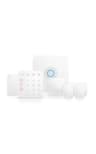
If your household already talks to Echos and you own or plan to own Ring cameras, this is the path of least resistance and the cheapest hardware route into the same capability set. The 8-piece kit publishes a base station with an up-to-24-hour backup battery, a keypad, four contact sensors, a motion detector and a range extender, and the sensors run on Z-Wave, so the system expands with a large catalog rather than only with Ring’s own parts. Professional monitoring exists when you want it, on a month-to-month plan.
The honest cons. The best features assume you buy into Ring more widely — which, given Ring’s per-device plan limit, means the monthly figure grows with the hardware count. Ring publishes cellular backup as a paid feature, so the free configuration is Wi-Fi only. The ecosystem is Alexa-centric: no Apple Home, and Google support is not the point of this product. And it is Amazon-owned, which for some readers is the entire reason they were looking at alternatives in the first place — our Ring Alarm review and SimpliSafe vs Ring Alarm treat that as a legitimate criterion rather than a footnote.
Why eufy wins on running cost and loses on everything else
The eufy 5-Piece Home Alarm Kit is the only system on this page where the total cost of ownership is the sticker price. eufy publishes a HomeBase 2, a keypad, a motion sensor and two entry sensors as a one-time purchase with no monthly fee, and the kit links to eufy’s local-storage cameras so the camera half of your system can be fee-free as well. For someone whose objection to SimpliSafe is the recurring bill as a matter of principle, this is the answer, and it is a coherent one.
The honest cons. There is no professional monitoring available at all, so nobody calls the police but you. Two entry sensors cover two openings, the thinnest layout here. No cellular backup is published. The ecosystem is smaller than Ring’s or SimpliSafe’s and ties you to the HomeBase. And eufy’s 2022 cloud-thumbnail disclosure is part of its record; our eufy alarm review carries it. If zero recurring cost is the brief, our no-subscription systems ranking is the deeper version of this pick.
What we left off, and why
The big monitored-service brands. ADT, Vivint and the rest are a different purchase: a quoted install, a longer commitment and a price that depends on your address. We cover Vivint in a review rather than ranking it against self-install kits, because comparing a boxed kit to a quoted contract on price alone would be misleading in both directions.
Camera-only “security systems.” A pile of cameras is surveillance, not an alarm — no siren, no entry sensors, nothing that reacts at the moment a door opens. If that is genuinely what you want, buy no-subscription cameras and skip the hub, but do not expect it to behave like a SimpliSafe replacement.
Abode’s Smart line and iota kits. They are the hubs that carry Apple Home, Z-Wave and Zigbee, and they are the right Abode for a smart-home household — but every kit in that line was unavailable on Amazon when we last swept the listings, so we rank the kit you can actually buy and state what it gives up.
So which one
Most people leaving SimpliSafe: Abode. Free self-monitoring that never expires, four openings covered in the box, and contract-free professional monitoring you can turn on for a fortnight and off again in the app.
An Alexa household, or the cheapest capable hardware: Ring Alarm. Free self-monitoring, Z-Wave expansion and a 24-hour backup battery — as long as you accept a plan for cellular backup and Amazon in the middle of it.
Zero recurring cost as a principle: the eufy kit. No fee exists, no plan to cancel, no dispatch service either.
And stay with SimpliSafe if what you actually want is the outdoor guard service. Pro and Pro Plus put live agents on your property overnight or around the clock, with the published “up to $500 toward your insurance deductible” Anti-Theft Guarantee behind it, and nothing on this page competes with that. Read our SimpliSafe review for that case, or our overall home security system ranking to see where all four land together. If the monthly bill is the whole problem, the matching camera page is best cameras without a subscription, and the matching doorbell page is Ring doorbell alternatives.