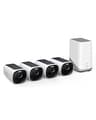
How to choose a wireless camera
Start with power, because it decides how much of your life the camera takes up. A plain batterycamera is the cheapest and simplest, but you’ll be bringing it down to charge every few weeks to a couple of months depending on traffic. A battery-plus-solarcamera — the eufyCam and the Reolink Argus here — tops itself up from a small panel, so in a spot that catches a few hours of sun it becomes genuinely set-and-forget. If your target location gets light, solar is almost always worth the small premium; if it’s in permanent shade, accept that you’ll be recharging. If you are still deciding whether a wire-free camera is the right tool at all, our wired vs wireless guide covers what a battery camera gives up — continuous recording, and detection through glass — in exchange for going anywhere. Take away the router as well as the outlet — an RV, a camper, a storage lot — and the ranking changes again, which is what our cameras for an RV or camper page is for.
Then settle the storage question
This is where wire-free cameras quietly split into “buy once” and “pay monthly.” The eufyCam records to a local HomeBase and the Reolink to a microSD card, both with no fee. Ring’s wire-free cameras store nothing without a Ring Protect plan— there’s no local option at all — and Blink’s included module can’t save clips on its own, so a true no-fee Blink setup means adding a Sync Module 2. None of that makes Ring or Blink bad cameras; it just means the sticker price isn’t the whole price. We break the Blink case down in the Blink Outdoor 4 review.
Match resolution and field of view to the job
For a wide yard you want either a high-resolution sensor or, better, the pan-and-tiltcoverage of the Reolink Argus, which sweeps an area a fixed camera would miss. 2K is plenty for a defined space; 4K helps only when you need to zoom in to read a face or a plate at distance. Color night vision usually matters more than raw megapixels for actually identifying someone after dark. And whatever you buy, secure it — a strong, unique password and two-factor authentication, per the FTC and CISA guidance we lean on across the site. Local-storage cameras have a privacy edge here, because the footage never has to leave your network. For the wider field including wired options, see the best security cameras roundup, and for the hardest wire-free case of all — a building with no outlet and weak Wi-Fi — the best cameras for a garage. If the spot you are covering is the drive itself, reach and vehicle detection reorder the list: best security cameras for a driveway ranks on those instead. Every camera here lives outdoors, so the published weather rating is worth two minutes of your attention: are security cameras waterproof? lists the IP code and temperature range each maker publishes, and the one warning that contradicts its own rating.
Two of the wire-free cameras here were under $100 at the last price refresh, and if that is your ceiling rather than the wiring, start at the best security cameras under $100, which ranks the whole shelf below the line including the wired options.