What each camera does with no plan at all
This is the comparison. Everything else is detail.
Wyze with no plan: it records. Wyze states that every Wyze Cam has a microSD slot, that you can choose Continuous or Events Only recording, and that local storage is free. The Cam v4 takes a card up to 256GB and records 24/7 to it. Wyze sells Cam Plus on top, and Cam Plus adds cloud event clips and smarter AI detection — but the camera’s core job, keeping footage of what happened, happens without it.
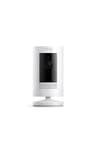
Ring with no plan: it watches. Ring’s own list of what works without a subscription covers Live View, motion alerts, two-way talk, motion zones and Alexa; what a plan adds is cloud video history, snapshots and person detection. In plain terms: with no plan you can look at the camera whenever you choose to, and you will be told when something moves, but there is no recording to go back to afterwards. The registry entry for this camera says it plainly because it is the single most important fact about it — no local storage at all.
Ring publishes what the plans buy: up to 180 days of video history, person, package and vehicle alerts, and on the top tier 24/7 professional monitoring. That is a real product and some people should buy it. It is just not the same product as a camera with a memory card in it.
The full comparison
Manufacturer-published figures only, read on the date at the top of this page. Ring's figures are for the Outdoor Cam (formerly Stick Up Cam 3rd Gen). | Wyze Cam v4 | Ring Outdoor Cam | Tapo C120 |
|---|
| Resolution | 2.5K (2560 x 1440) | 1080p HD | 2K QHD (4MP) |
|---|
| Night vision | 4 x 850nm IR + starlight sensor, 2 spotlight LEDs | Infrared plus Color Night Vision | 850nm + 940nm IR to 30 ft, starlight sensor |
|---|
| Field of view | 115.8° diagonal | 110° horizontal / 57° vertical | 120° diagonal |
|---|
| Footage lives on | microSD up to 256GB | Ring cloud only | microSD up to 512GB |
|---|
| Records with no plan | Yes, 24/7 to the card | No — recordings need a Ring plan | Yes, continuous to the card |
|---|
| Free without a plan | Everything the camera does | Live View, motion alerts, two-way talk, Alexa | Everything the camera does |
|---|
| Power | Wired USB | Battery, plug-in or solar (model-dependent) | Wired |
|---|
| Wi-Fi | 2.4GHz only | 2.4GHz (dual-band on the Plus model) | 2.4GHz only |
|---|
| Weather sealing | IP65 | -5°F to 122°F rated | IP66 |
|---|
| Siren | 99dB | Remote-activated siren | 96dB |
|---|
Read the fifth row, then the first. The Wyze is sharper and records for free; the Ring is the only camera here that cannot keep a clip on its own. On hardware the Wyze also wins the resolution round and ties or beats Ring on night vision, because Wyze publishes four 850nm infrared LEDs, two spotlight LEDs at 72 lumens and a starlight sensor, where Ring publishes infrared with Color Night Vision but no LED count or range. Where a maker does not publish a figure we leave the cell honest rather than estimate it.
Where Ring genuinely wins
Three places, and they are not nothing.
Power flexibility. Ring publishes battery, plug-in and solar options for the Outdoor Cam. The Wyze Cam v4 is USB-wired only, which means it has to live near an outlet — fine indoors or under an eave with a cable, useless on a fence post. If the spot you need covered has no power, Ring is in the conversation and the Wyze is not. Our wireless camera picks are the better answer to that problem than either of these two.
Ecosystem. If your house already runs on Echo devices, Ring is the camera that shows up on the Echo Show without being asked, announces the motion in the hall and arms with the rest of the house in one routine. That coherence is real and it is why people buy Ring knowing about the fee.
Professional monitoring. Ring’s top plan includes 24/7 professional monitoring, which no Wyze camera offers at all. If what you actually want is someone to call the police when the alarm goes off, you are shopping for a monitored alarm rather than a camera — see DIY vs professional monitoring before you decide a camera subscription is the thing to buy.
Where Wyze costs you something
Two honest cautions, because a cheap camera that you later regret is not a saving.
The first is that the free tier has an edge to it. Local recording is free and continuous, but Wyze’s smarter detection — the person and package alerts that stop your phone buzzing at every passing car — is what Cam Plus is for. You can run the camera entirely without it; you will just get more alerts that turn out to be a cat.
The second is Wyze’s security history, which is mixed and which we say on every Wyze page rather than only when it suits the argument. A camera inside your home is a different trust decision from one on the driveway, and our guide to securing smart home devices is worth ten minutes before you put any brand’s camera in a bedroom.
The third camera that beats both
If the only reason you are considering Ring is that the Wyze needs a cable, buy a battery camera instead of a subscription. And if you want the Wyze proposition with better sealing and twice the card capacity, the Tapo C120 is the quiet answer: TP-Link publishes 2K QHD, a starlight sensor, 850nm and 940nm infrared LEDs rated to 30 feet, IP66 sealing and a microSD slot up to 512GB, with continuous recording supported on wired models. It is the pick on our indoor camera ranking for the same reasons, and Wyze vs Tapo settles that one properly.
For the wider version of this argument — what every camera we cover costs to run rather than to buy — start with the best cameras without a subscription, and do security cameras work without a subscription? explains brand by brand what you keep when you stop paying. If you are weighing Ring against its sister brand rather than against Wyze, Ring vs Blink is the comparison you want.