The three ways a thermostat can “work with Alexa”
1. Alexa built into the thermostat
Only one pick does this. ecobee’s Smart Thermostat Premium “comes with Siri and Alexa Built-in” — you choose which at setup — so the thermostat on the hallway wall is itself an Alexa device. Say “Alexa, set the heat to 68” standing in the hallway and the thermostat itself responds. For a home with Echo devices in some rooms but not the hallway, that fills a gap without buying another speaker. It is also the only pick here that ecobee lists as working with Apple Home, Alexa, Google and SmartThings all at once, which is why it wins our standalone review as well.
2. The thermostat that lives in the Alexa app
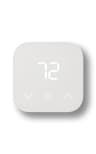
The Amazon Smart Thermostat is the purest version of this. Amazon states plainly that it “doesn’t have a speaker or microphone”; for voice control you use “a compatible Alexa-enabled device, like an Echo, or the Alexa app.” Setup, schedules and Alexa’s Hunches — Amazon’s automatic temperature suggestions, documented on its own thermostat help pages — all happen in the Alexa app, because there is no other app. If every other smart device you own is already in that app, this is the simplest thermostat there is. It is also, by design, Alexa-only: Amazon lists no Google Home or Apple Home support, so it is the one pick you cannot take with you if you change ecosystems.
3. A Google thermostat that Alexa reaches through a skill
The two Nest thermostats are Google devices first. Google’s help page describes what Alexa can do with them through the Google Nest skill: read the temperature, set it to a number, nudge it up or down, and switch modes between Heat, Cool, Heat-Cool and Eco. It also lists what Alexa cannot do — control the thermostat while it is set to an Eco temperature, in Off mode, running Emergency Heat or after an emergency shutoff — and notes that you need a Google Account with the Nest account migrated to it. Both Nests also carry Matter, which gives Alexa a second, more direct route to the same basic controls. For “Alexa, make it warmer,” this works fine. For scheduling and energy history you will be in the Google Home app, not the Alexa one.
The C-wire question, which decides more installs than Alexa does
A smart thermostat needs constant power, and in many older homes the thermostat wiring has no “common” wire to supply it. This is the single most frequent reason a smart thermostat goes back in the box, and the four picks handle it very differently. Amazon’s own listing title for the Smart Thermostat ends with “C-wire required”; there is no adapter in the standard box, though Amazon sells a bundle with one. ecobee’s Premium includes a Power Extender Kit for homes without a C-wire. Google’s Nest Thermostat and Nest Learning Thermostat may need a C-wire or Google’s separate power connector depending on your system. Before you buy any of them, pull the old thermostat off the wall, photograph the terminals and read what is a C-wire? — it takes five minutes and it is the difference between a Saturday project and a Saturday refund.
The picks compared
Manufacturer-published capabilities, read on the date at the top of this page. | ecobee Premium | Amazon Smart Thermostat | Nest Thermostat | Nest Learning (4th gen) |
|---|
| How Alexa reaches it | Built into the thermostat | Alexa app; voice via an Echo | Google Nest skill, or Matter | Google Nest skill, or Matter |
|---|
| Microphone / speaker on the wall | Yes | No | No | No |
|---|
| Also works with | Apple Home, Google, SmartThings | Alexa only (Amazon lists Ring) | Google Home, Matter | Google Home, Matter |
|---|
| Room sensor in the box | Yes (SmartSensor) | No | No | Yes |
|---|
| No-C-wire adapter in the box | Yes (Power Extender Kit) | No — C-wire required | Not in the box | Not in the box |
|---|
| Learns a schedule by itself | Schedules + occupancy | Alexa Hunches | Auto-scheduling from habits | Yes, auto-learning |
|---|
| Subscription | None | None | None | None |
|---|
The ecobee is first because it is the only thermostat here where “works with Alexa” means the thermostat is an Alexa device, and because it ships with the two things the others make you buy or wire: a room sensor and a no-C-wire adapter. It is usually the most expensive of the four — check the live price — and it earns the gap. The Amazon Smart Thermostat is second for the opposite reason: it is often the cheapest smart thermostat worth owning, it is built with Honeywell Home thermostat technology, and if you are all-in on Alexa the absence of any other app is a feature. The two Nests are third and fourth not because they are worse thermostats — the Nest vs ecobee comparison shows how close that is — but because for an Alexa household they are the arrangement with the most seams.
When to pick the Nest anyway
Two situations. The first is a mixed house: a Nest Hub in the kitchen, an Echo in the bedroom. The Nests are the only picks here that Google Home controls natively, and Alexa reaches them well enough for the commands people actually say out loud. The second is price. The Nest Thermostat is frequently close to the Amazon Smart Thermostat on price while carrying Matter and Google Home support the Amazon lacks — our Nest vs Amazon Smart Thermostat page is that exact decision. Go to the Learning Thermostat only if you want the auto-learned schedule and the included sensor; for a simple single-zone home it is more thermostat than the job needs, as our review says.
Does an Alexa thermostat save money?
Sometimes, and not because of the voice part. The U.S. Department of Energy’s position on connected thermostats is that the savings come from setbacks — heating and cooling less when nobody is home or everyone is asleep — and a smart thermostat mostly earns its keep by doing that automatically instead of relying on you to remember. ecobee publishes a claim of up to 26% savings on annual heating and cooling costs against a constant 72°F hold, with the comparison stated in the footnote, and lists the Premium as ENERGY STAR certified; Amazon’s listing title for the Smart Thermostat leads with “Save money and energy.” Neither claim is ours, and the real figure for your house depends on how much heating you were wasting to begin with. Our guide to whether smart thermostats save money walks through the math honestly, and the running-cost guide puts it alongside everything else in the house.
The Alexa part earns its keep differently: an Echo Dot in the bedroom means the thermostat gets adjusted at 11pm without anyone getting up, and a Routine can drop the heat when the last person says goodnight. If you do not yet own an Echo, our Echo Dot review explains why it is the first device we tell most beginners to buy, and the beginner picks lay out the order to add the rest.